Filter offers.
Don't get filtered.
Seekiee is an open-source, AI-powered job-search command center that runs inside your CLI. Evaluate roles, generate tailored CVs, and track every application — all on your machine.
git clone https://github.com/05-deepak-patidar/seekiee-public.gitWorks with any AI coding CLI




What is seekiee?
seekiee is an open-source AI-powered job search system that runs locally on your machine inside any AI coding CLI — Claude Code, Codex, OpenCode, Gemini CLI, Qwen, or GitHub Copilot. It evaluates job listings against your CV using a six-dimension rubric scoring 1.0–5.0, generates ATS-optimized PDF resumes tailored per role, drafts answers to open-ended application questions on Greenhouse, Ashby and Lever forms, scans 150+ company portals zero-token, and tracks the pipeline in a Go-based terminal dashboard. Everything lives on your machine: no cloud, no telemetry, no account. MIT-licensed and free forever; the only cost is whichever AI coding CLI you already pay for.
1stars · Open source · MIT
Turn any AI coding CLI into a full job-search command center.
AI-native & agnostic
Works with any coding CLI — Claude Code, Codex, OpenCode, Gemini CLI, Qwen, GitHub Copilot. Built on the Open Agent Skill Standard, so you swap engines freely as better models ship.
Scored, not sprayed
A six-dimension rubric rates every role 1.0–5.0 against your CV with citations. Below 4.0, the agent tells you not to apply — your time and the recruiter's are both worth protecting.
Drafts the answers
/seekiee apply reads Greenhouse, Ashby and Lever forms and drafts every open-ended answer from your CV. You edit and submit — it never clicks for you.
150+ portals, zero tokens
Pre-configured scrapers check 150+ career pages on demand for zero API cost. Run /seekiee scan and get a ranked list back in minutes.
Shipped with the community
seekiee grows through pull requests from people running real job searches. Issues get triaged fast; fixes ship the same week.
Join 0+ buildersgit clone https://github.com/05-deepak-patidar/seekiee-public.gitFrom a job link to a tailored application in one command.
Paste a job
Drop a posting URL or raw text into your CLI. Seekiee reads the role, requirements, and compensation.
It scores the fit
A six-dimension rubric rates the role 1.0–5.0 against your CV, citing the exact lines that match — and the gaps.
It tailors your CV
An ATS-optimized PDF resume is generated for that specific role, plus paste-ready answers to open-ended questions.
It tracks everything
Every evaluation lands in a local pipeline tracker. No spreadsheet, no cloud, no account.
“Companies use AI to filter candidates.
I just gave candidates AI to choose companies.”
100% open-source.
1 stars0 forks
The full scoring methodology is published. Now powered by the community.
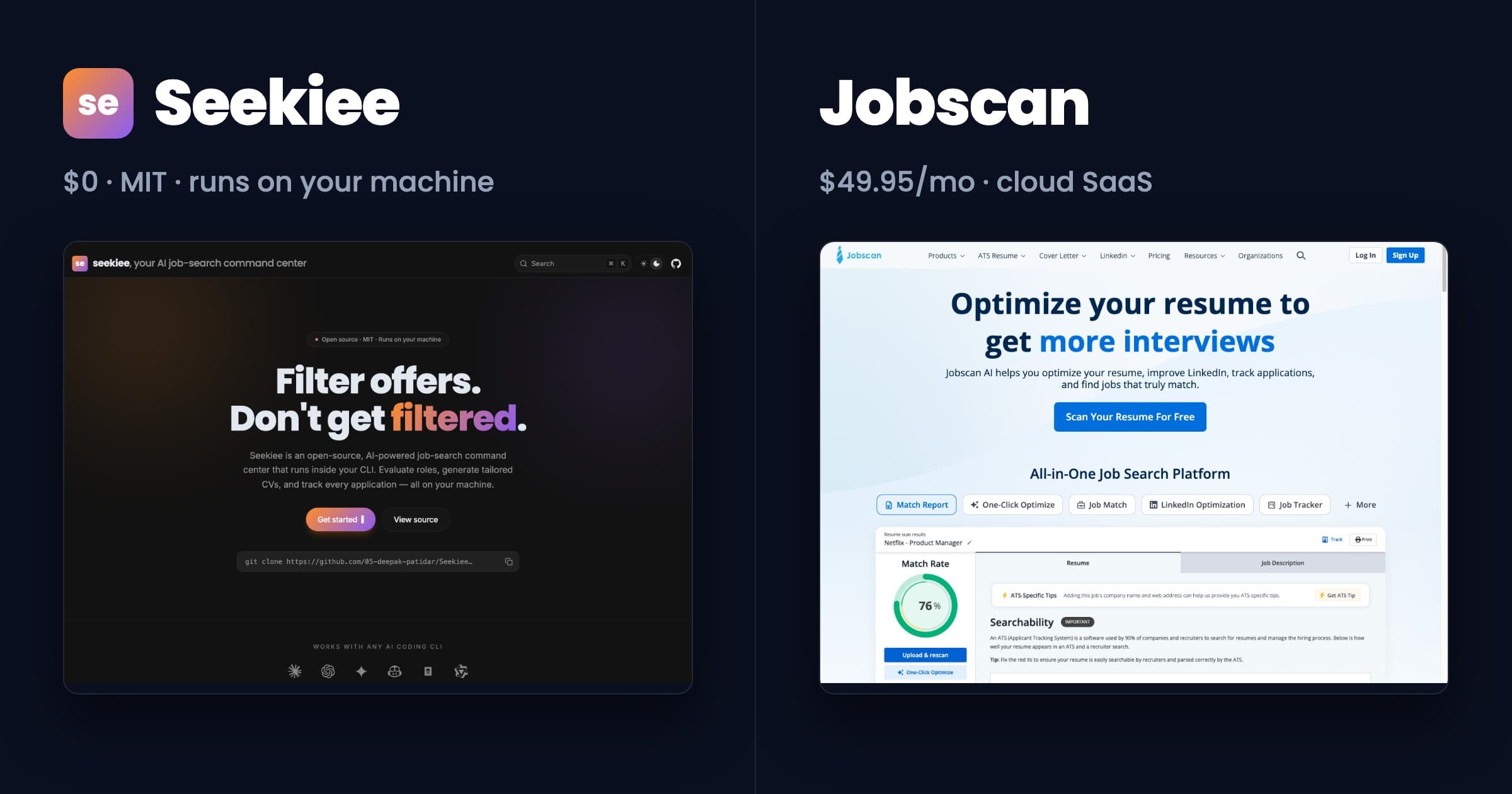
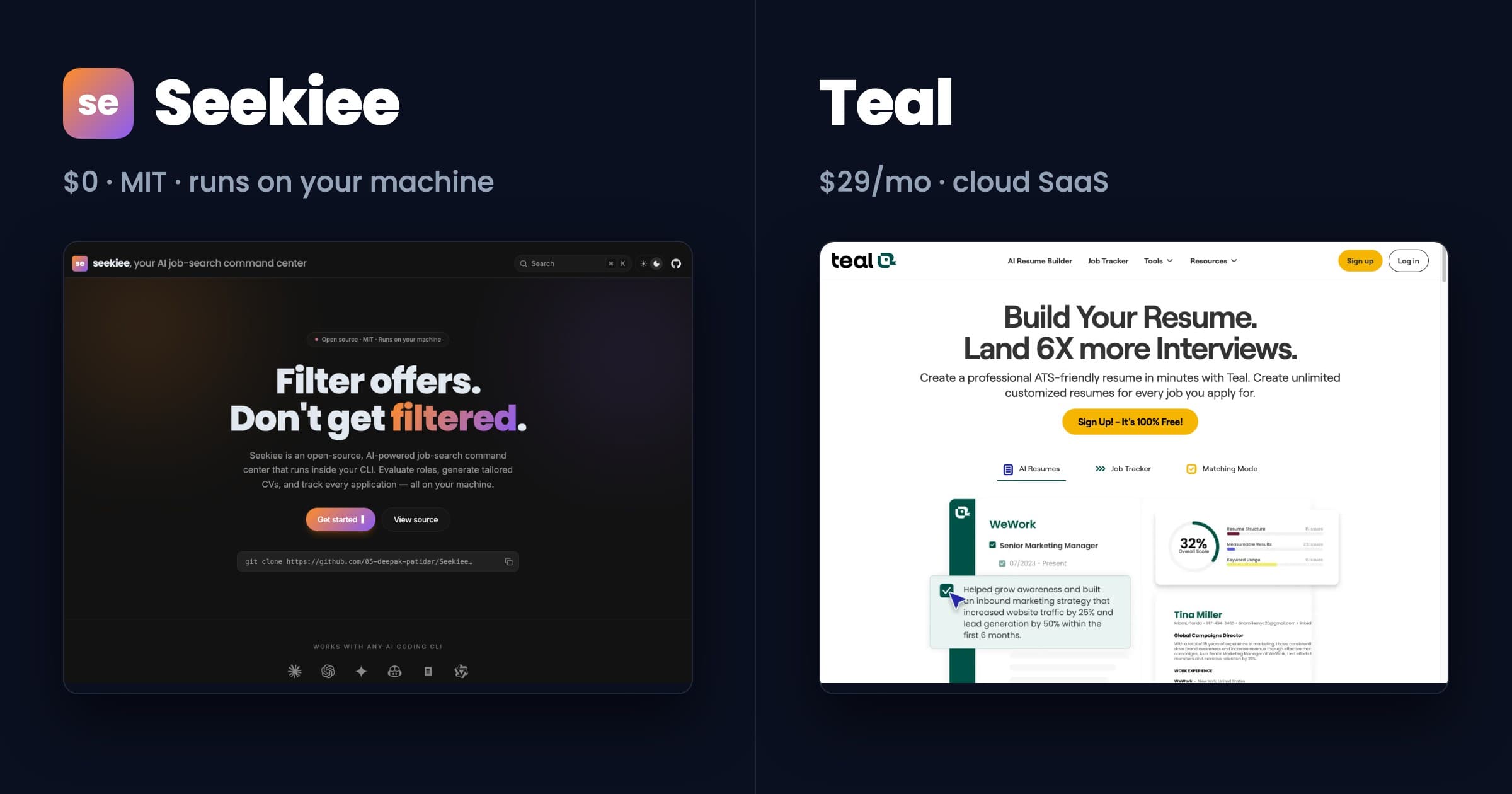
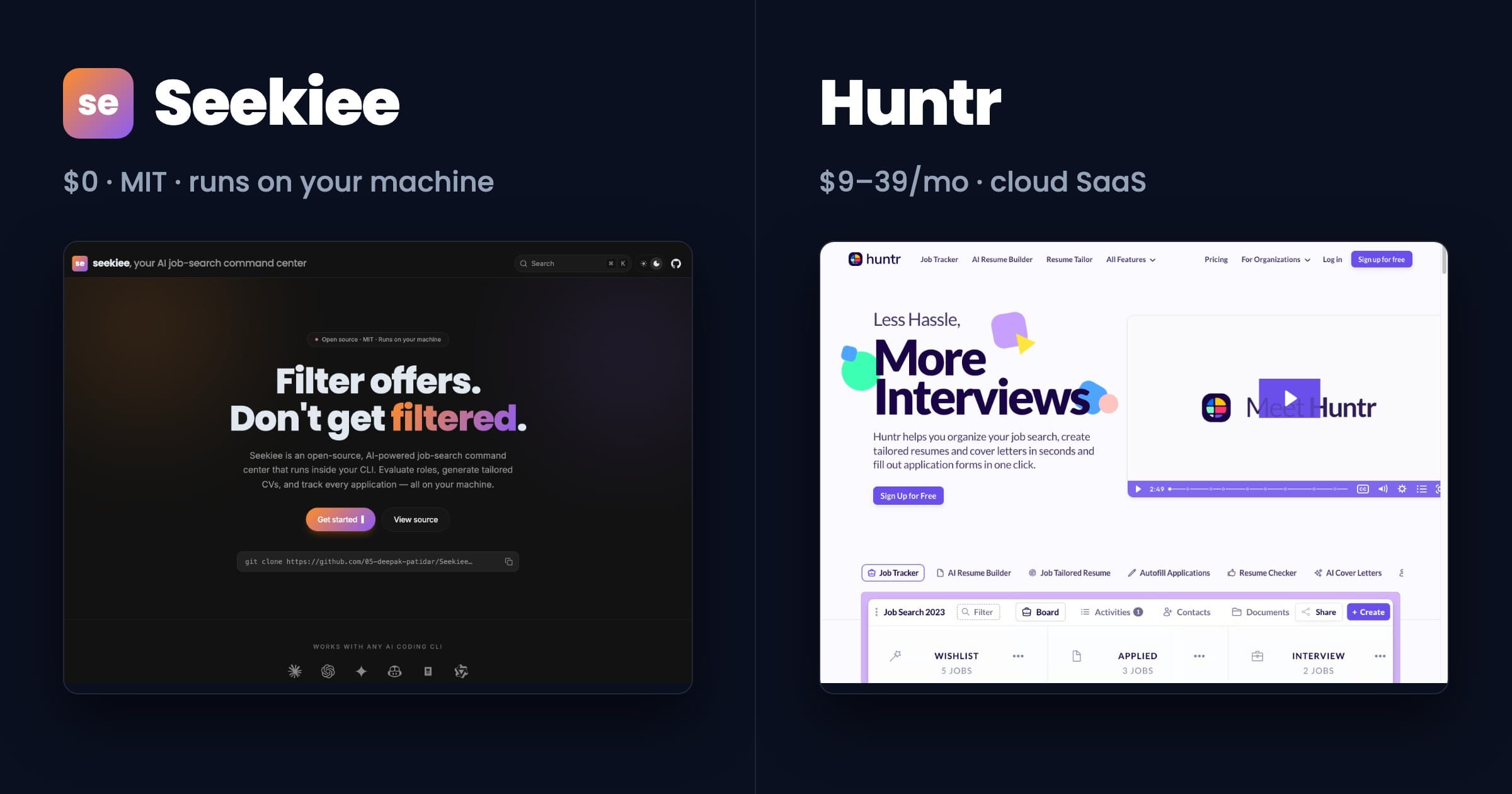
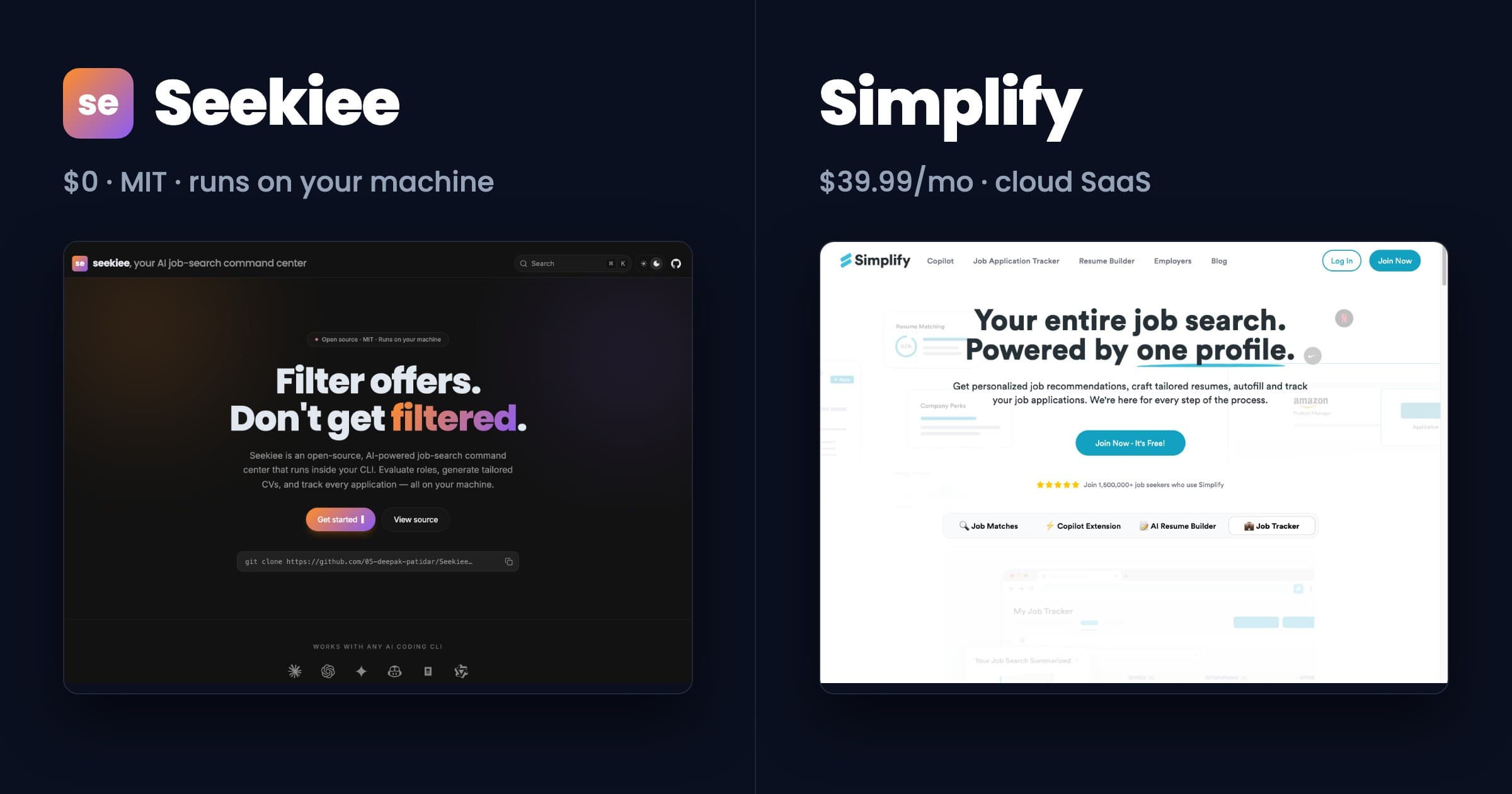
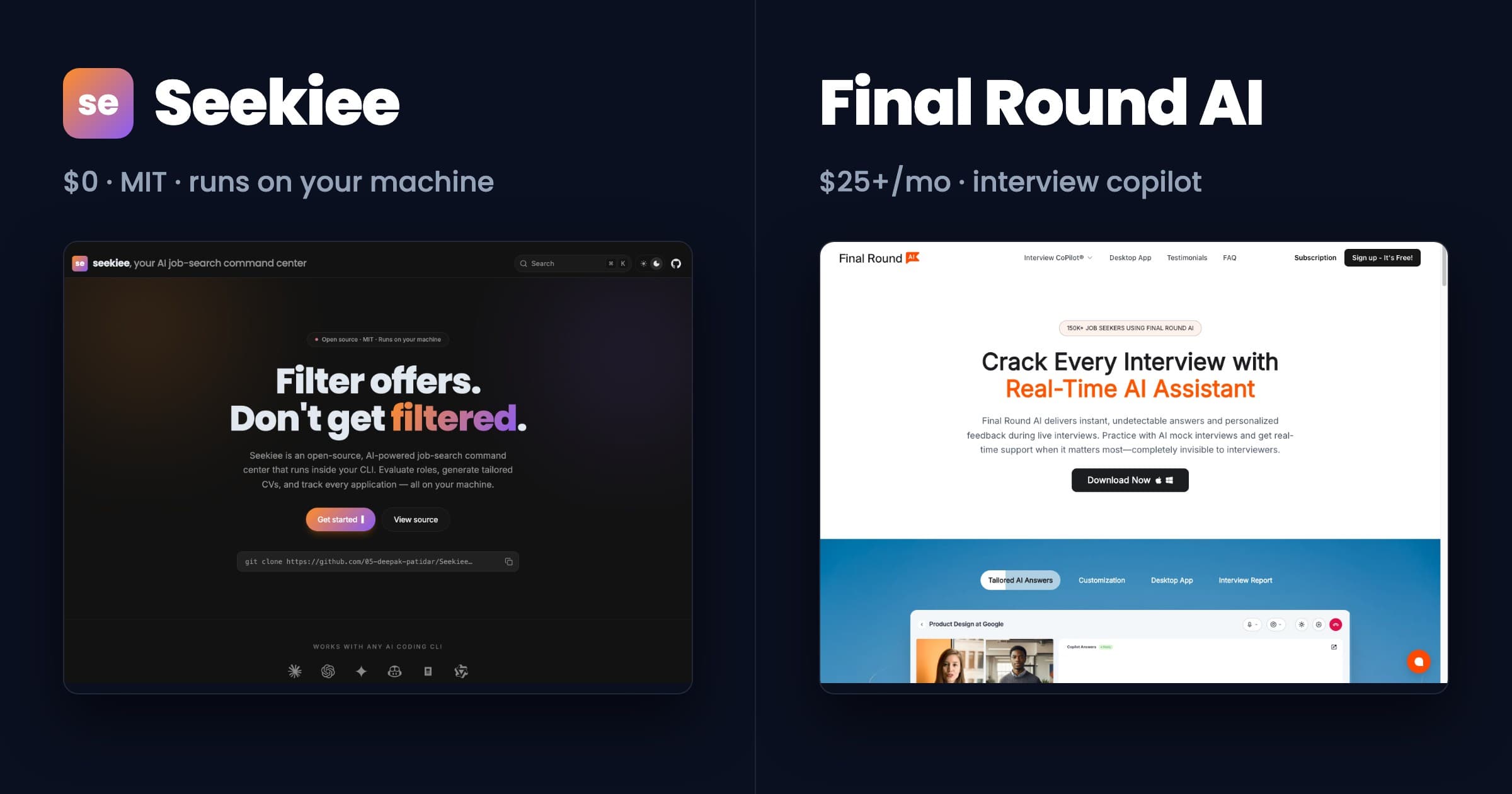
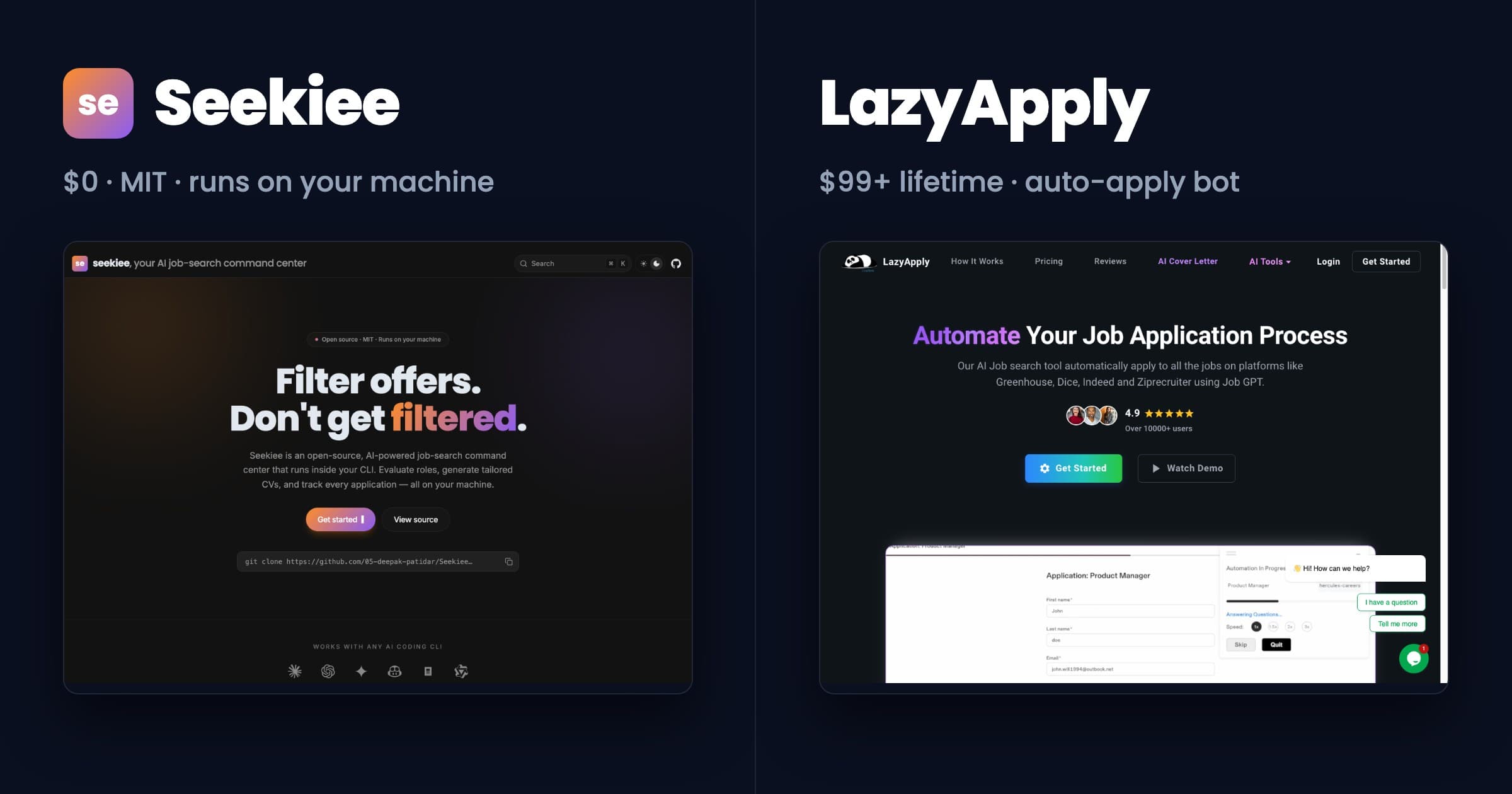
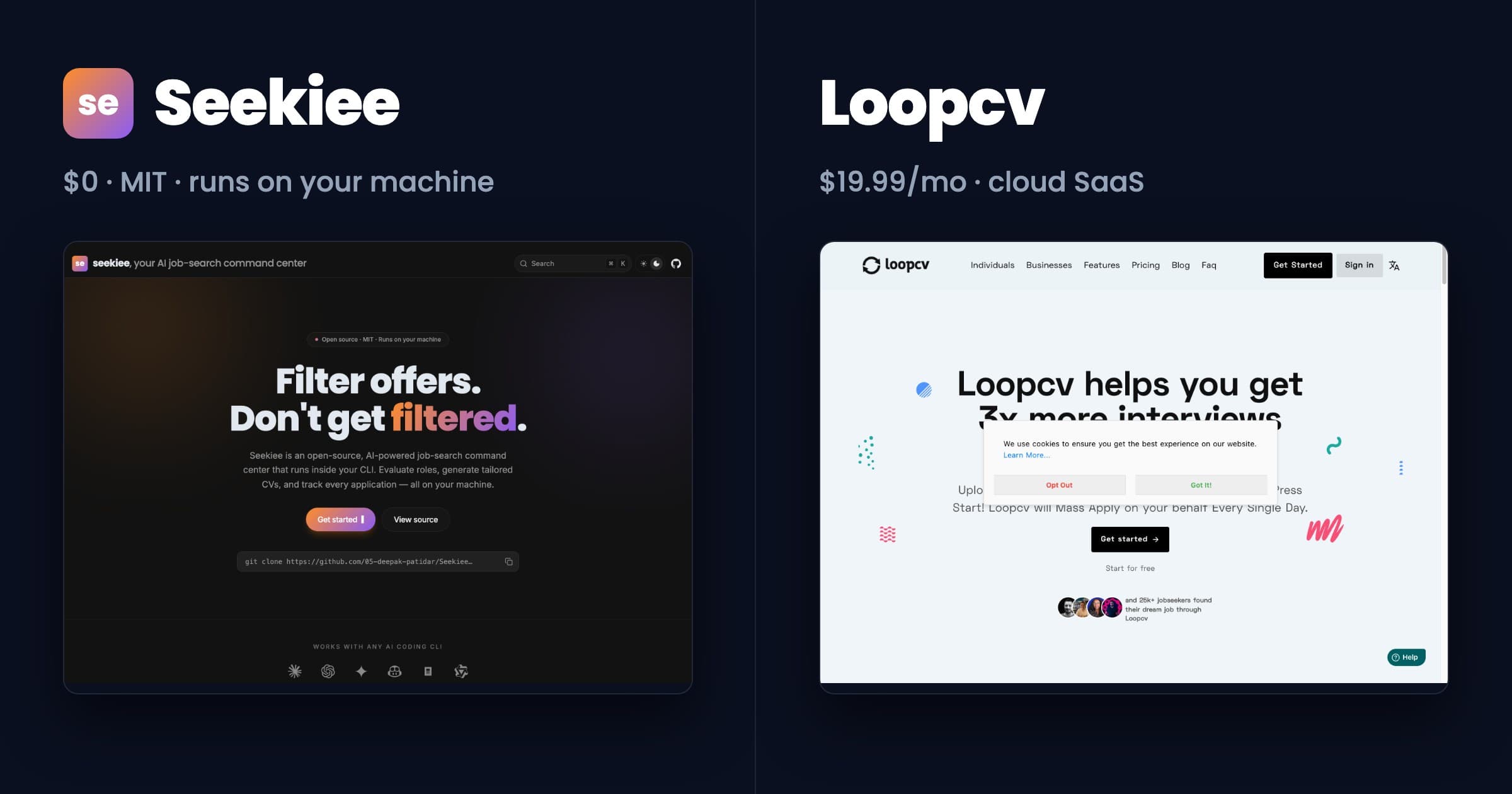
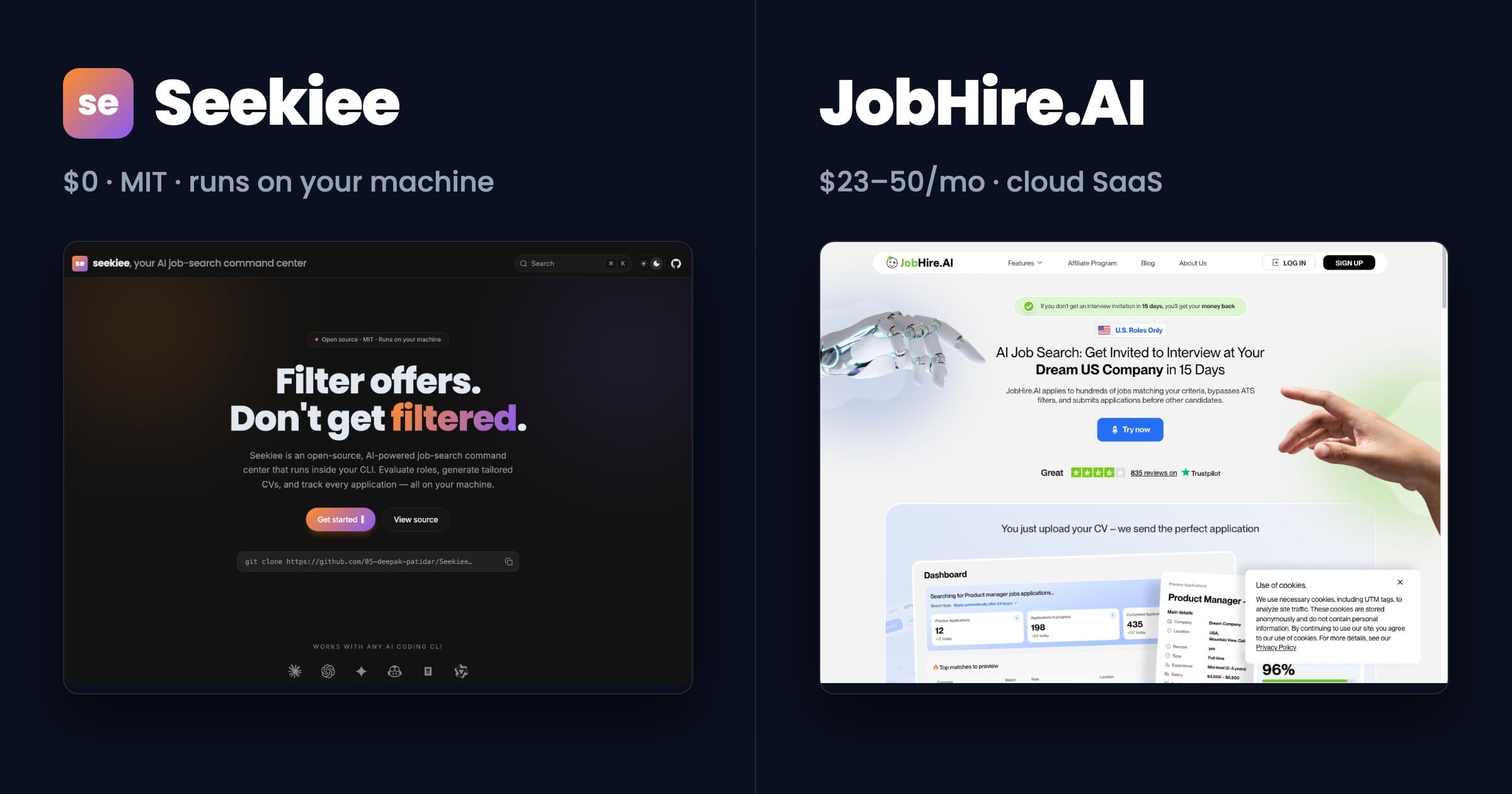
Comparing tools?
Side-by-side honest comparisons. Feature matrix, pricing, the killer feature none of them ship.
Frequently asked
- How does seekiee score job listings?
- seekiee uses a rubric-guided LLM evaluation across six dimensions — match, north-star alignment, comp, cultural signals, red flags, and global fit — producing a 1.0–5.0 score with citations to specific CV lines and JD requirements. Anything below 4.0 the agent recommends against applying. No closed-form formula, no spray-and-pray. The full rubric is published at seekiee-docs.darkiee.com/methodology.
- Is seekiee free? What is the business model?
- seekiee is permanently free, MIT-licensed, and community-funded. There is no paid tier, no waitlist, no account, no telemetry, and no premium features. You clone the repo, configure your profile, and run the system locally with whichever AI coding CLI you already use. Sustainability comes from voluntary community patronage via GitHub Sponsors — not from premium tiers, paid features, or data. The maintainer has other paid work for income; sponsorship enables deeper focus on the project. See seekiee-docs.darkiee.com/sustain for details.
- Who builds seekiee?
- Seekiee is an open-source project maintained by Darkiee. It was built to close the asymmetry between recruiter-side AI (which filters candidates at scale) and candidate-side tooling, and open-sourced under MIT so anyone can run it locally through the AI coding CLI they already use.
- Is seekiee a Claude Code skill or a standalone tool?
- seekiee is CLI-agnostic. It works with Claude Code, Codex, OpenCode, Gemini CLI, Qwen, and Copilot — whichever AI coding agent the user already pays for. The skill files (
modes/) live in the repo as plain markdown prompts; any agent that supports skill loading can invoke them. There is no Anthropic-specific dependency. Claude Code happens to be the most common runtime because of its skill loader, but the same modes run unchanged in the other CLIs. - How is seekiee different from other AI job search tools?
- Most AI job search tools — Jobscan, Teal, Huntr, autoapply.ai — are cloud SaaS products that upload your resume and job data to their servers, charge $20–80/month, and keep their matching algorithm closed. seekiee is the inverse: open source, MIT-licensed, runs locally on your machine through whichever AI CLI you already use, and publishes the full evaluation rubric. The only recurring cost is your AI CLI subscription. Side-by-side comparisons at seekiee-docs.darkiee.com/compare.
- What AI tools does seekiee work with?
- Claude Code (primary), Codex (OpenAI), OpenCode, Gemini CLI (Google), Qwen, and GitHub Copilot. The same mode files run on all six. Each user picks the CLI that fits their existing subscription and cost preferences — seekiee never locks you to one provider. A typical job search runs on Claude Pro at $20/month, but the choice is yours.
Ready to filter offers, not get filtered?
Or follow what we ship.
Release announcements and occasional updates.
Unsubscribe anytime.